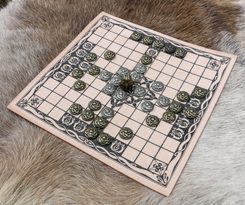
The Celtic game of Fidchell or Gwyddbwyll, which according to legend was invented by the God Lugh, and played by the Irish hero Cú Chulainn or King Arthur. Play this game too!
We are proud to be able to provide it to you as a work of art with a deeper idea, with the help of South Bohemian artist Kati.
The game presents the clash between the invaders who decided to take over Ireland and the defenders of this island facing the king.
Playing stones
The King - is represented by the menhir of Lia Fáil, the Stone of Destiny or the Coronation Stone on Mount Tara. It is the seat of Ireland's highest kings (Árd Rí Éireann in Irish). The stone depicts Celtic swords and a spiral ornament of torques, emphasising the importance of the king.
The King's retinue - the defenders of the island. Quadrilateral playing stones with motif of torques decoration from the site of Clonmacnois, Ireland (3rd century AD).
Raiders - round tokens with motif of attacking ships.
Fidchell (Irish) or also gwyddbwyll (Welsh), guidpoill-gwezboell (Breton), gwydhbol (Cornish) is a board game popular among the Celts.
Fidchell is played between two players and translates as "wood knowledge" or "wood sense". Fidchell / gwyddbwyll is often mentioned in old Celtic legends.
The origin of Fidchell could be derived from the Roman game ludus latrunculorum. An archaeological find such as the game from Stanway, Colchester with 13 pieces on each side may also represent the Celtic board game Fidchell.
Some of the rules of the game can be derived from references in early Irish literature.
Leth a fóirni d'ór buidi, in leth aili d'findruine - "Half the pieces were of yellow gold, the other half of white bronze".
Legends describe fidchell as a game played by kings and gods. Legend has it that it was invented by Lugh, the God of light and inspiration, and played skillfully by his son, the Irish hero Cú Chulainn. According to legend, King Arthur and Owain mab Urien also played the game with golden playing stones on a silver board.
A find from Ballinderry (Ireland) made in 1932 probably represents fidchell. It is a wooden board with Celtic symbols, with a 7x7 grid, bordered by 49 holes.
- Material: zinc with antique brass and antique silver finish
- The game is supplied without the board
- Own production
- Design - Katien


Related products