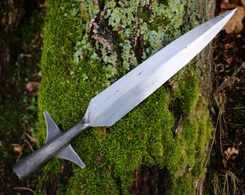
Bardiche axe, late 15th century, province of Småland, Sweden.
This long-bladed weapon is characteristic of Northern European polearms of the late 15th century. The exceptional blade length (55 cm) indicates specialization for powerful cutting blows delivered from a long shaft that could reach the height of a man or more. The wide, crescent-shaped blade allowed not only devastating strikes against lightly protected opponents, but also effective blows against plate armour — especially when combined with a hook or spike, if the weapon was so equipped.
Archaeological and historical context
Finds and iconographic sources from Scandinavia show that long cutting polearms were a common part of the equipment of both urban militias and noble retinues in the 15th century. The region of Småland belonged in the late Middle Ages to areas with significant military mobilization, particularly in the context of the conflicts of the Kalmar Union and frequent internal political struggles between the Swedish nobility and the Danish Crown.
Typologically, this weapon can be classified within the broader group of Northern European long axes that developed from older Scandinavian traditions (ultimately linked to Viking axes), yet structurally responded to changes in armour during the 15th century. The massive blade was usually riveted or socket-mounted to a wooden shaft; in some examples, the upper part of the blade extends into a spike, allowing thrusting techniques.
Archaeological finds from southern and central Sweden — including hoards and isolated discoveries from former battlefields — demonstrate that this type of weapon was not merely ceremonial. Rather, it was a fully functional combat tool. Surviving pieces often bear traces of resharpening and repairs, indicating long-term use.
It was particularly effective:
-
against infantry in tight formations,
-
for breaking shield lines,
-
for hooking and pulling an opponent from horseback (if fitted with a hook),
-
during siege operations, allowing reach over walls or palisades.
In Northern Europe, this weapon type remained in use longer than in some parts of Western Europe, where it was gradually replaced by more complex halberds and spiked maces.
Our replica is based on a find from Småland, preserved in the Livrustkammaren in Stockholm, and represents a valuable example of regional late medieval arms production. The collections of this institution include numerous surviving edged weapons documenting the transition from medieval modes of combat to early modern forms of organized infantry.
- Blade length: approx. 55 cm
- Hand forged
- Edge – blunt or sharp
- The axe is supplied without wooden shaft


Related products