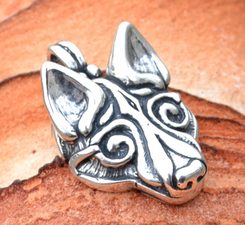
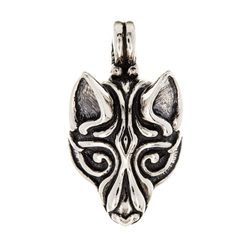
The stainless steel Fenrir pendant takes the form of the head of a wolf that even the gods feared in Norse myths. At 55 mm high and weighing 33 g, it is a substantial piece of jewellery that can be both seen and felt on the neck. It suits concerts as well as everyday wear for anyone with an interest in Norse mythology, pagan symbolism or Viking metal.
- Height: 55 mm
- Width: 35 mm
- Weight: 33 g
- Material: stainless steel
Fenrir and the bond that looked like a ribbon
Fenrir, son of Loki and the giantess Angrboða, broke the first two bonds with which the gods tried to restrain him. The third time, they laid Gleipnir before him. It looked like a soft ribbon, but the dwarves had made it from things that cannot be grasped, such as the sound of a cat's footfall or the roots of a mountain. Fenrir suspected a trick and agreed to the test only on condition that one of the gods placed a hand in his mouth as a pledge. Týr did so. When the bond only tightened as the wolf struggled and the gods did not release him, Týr lost his hand.
Fenrir at Ragnarök
At Ragnarök, Gleipnir will give way. Snorri describes Fenrir's arrival with the image of a gaping mouth, its lower jaw reaching the earth and its upper jaw the sky. The wolf will devour Odin. Odin's son Víðarr then steps forward against him and sets his foot in the wolf's mouth, wearing a shoe made from scraps of leather that people have set aside over the ages when making footwear. It is precisely this ordinary detail that gives the scene its particular force. At the decisive moment, Víðarr relies on something that was created over generations from humble leftovers.
The wolf head as a symbol
Fenrir's story holds both strength and distrust of those who gave him their word. The wolf head can therefore recall a longing for freedom as well as the price that both sides pay in the story. It depends which view is closer to you: the wolf, who rightly suspected betrayal, or Týr, the only one of the gods willing to place his hand in its mouth.


Related products