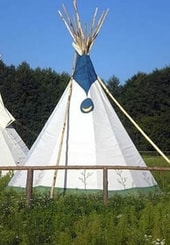
Teepee, also known in Czech as týpí, is a traditional tent of the nomadic Native American tribes of the Great Plains, designed for quick assembly, disassembly, and everyday family life. In our region, it is widely used in forest kindergartens, for children's summer camps, and more and more people are getting one for their garden, where it also serves as an alternative accommodation for guests. It has a conical shape, consisting of wooden poles and a cover, with an inner lining as part of the structure. The cover is stretched around the poles and sewn together at the front with wooden pins, while the lower edge is secured to the ground with pegs or stones. The teepee is comfortable because it allows a fire to be lit inside, ensuring warmth for sleeping. Smoke escapes through an opening between two smoke flaps, which regulate ventilation.
Lining, also known as the dew cloth, lines the inside of the tipi – increasing comfort, helping to block cold air flowing in from the sides, and if you plan to make a fire inside, it becomes almost a necessity. Linings consist of three parts and, when set up, have a height of 1.5 – 2 meters. They are long enough to cover the entrance, even if the tipi is set up in a wide configuration.
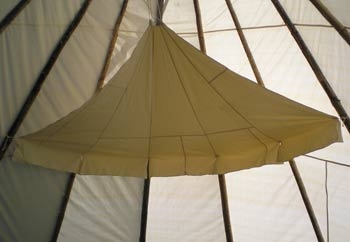
Ozan, also called the "sky cover," beautifully complements the tipi interior and adds comfort: it directs the smoke flow, catches falling ash, and helps retain heat.
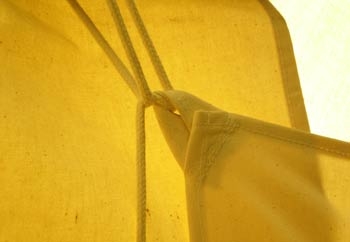
Instructions for setting up a TIPI:  - Download HERE
Tipis naturally come in different styles of various prairie tribes, and this choice does not affect the price.
MATERIALS:
Cotton tent fabric 280 – 300g/m2 (recommended for seasonal use)
Canvas fabric 380 – 420g/m2 (for year-round use).
Both materials come with water-repellent and anti-mildew treatment. The tents are supplied in their natural color. Painting is available for an additional charge.
Tipis can be purchased with a lining and ozan. The tipi frame is not included in the price.