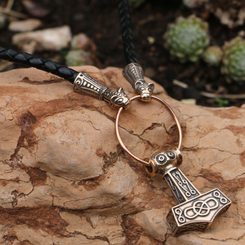
The Rømersdal Thor's hammer is a solid double-sided stainless steel pendant based on a Viking find from the Danish island of Bornholm. The hammer measures 40 × 40 mm and has a bail hole 5 mm in diameter, so it can be worn on a chain or on a leather cord. It is a distinctive pendant for followers of Norse paganism and admirers of Viking jewellery modelled on archaeological finds.
- Dimensions: 40 × 40 mm
- Bail hole diameter: 5 mm
- Weight: approx. 8 g
- Design: solid double-sided pendant
- Historical model: Rømersdal, Bornholm, Denmark
- Material: stainless steel
Thor's hammer from Rømersdal on Bornholm
This replica of Thor's hammer is modelled on a silver pendant from the second half of the 10th century, found at Rømersdal on Bornholm. The original is held in the collections of the National Museum of Denmark in Copenhagen. The replica transfers the form of the Bornholm piece of jewellery into stainless steel.
Thor's hammers from Denmark
Among the most interesting Danish finds is the Thor's hammer from Købelev on the island of Lolland. Someone engraved the runic inscription hmar is, meaning "This is a hammer", into this small 10th-century pendant. Thanks to it, we know today what name was given to this shape by a person from the time when such pendants were worn.
Another perspective is offered by the casting mould from Trendgården in northern Jutland. In a single piece of soapstone, a craftsman carved shapes for both Thor's hammer and Christian crosses. One mould thus brought together jewellery of two religious traditions that existed side by side in 10th-century Denmark.
Denmark in the Viking Age
The Danish islands and the Jutland peninsula lay on the sea routes between the North Sea and the Baltic. Goods and silver flowed through trading centres such as Ribe and Hedeby. The rise of royal power is described by the Jelling runestone, on which Harald Bluetooth commemorates the unification of Denmark. The Bornholm hammer dates from precisely this period.
Mjölnir as a sign of Thor's protection
In Norse myths, Thor protects the world of the gods from giants with Mjölnir. When he throws the hammer, it finds its way back into his hand. For a person who wears Thor's hammer today as a sign of pagan faith, it may serve as a reminder of how Thor's strength appears in the stories: to stand up for one's home and for the people who rely on it.


Related products