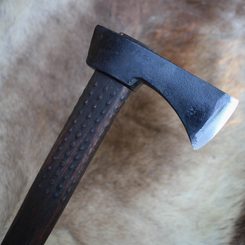
Miniature of Jánošík's Shepherd's Axe (Valaška) in the form of a necklace pendant. This miniature replica depicts a historical axe attributed to the legendary Slovak outlaw Juraj Jánošík. The pendant is cast in bronze using the lost-wax casting technique, preserving even the finest details.
- Material: bronze, garnet
- Dimensions: 28 × 47 mm
- Made in our own workshop
Juraj Jánošík's Shepherd's Axe is one of the most famous symbols of Slovakia's outlaw tradition. After Jánošík's death, the axe reportedly came into the possession of the Hungarian noble Szentiványi family, where it was passed down through generations. In 1813, it was donated to the Hungarian National Museum in Budapest. The axe has an oak shaft and a steel head, while the handle is covered in leather and reinforced with brass wire. In 1957, it was transferred to the Historical Museum in Bratislava. According to museum curator Michal Pírek, it is one of the oldest shepherd's axes documented in written records and most likely belonged to Jánošík himself.
Juraj Jánošík (1688–1713) was a legendary Slovak outlaw who became a symbol of resistance against oppression and injustice. He was born in the village of Terchová, at the foot of the Malá Fatra mountains, part of the Western Carpathians. Together with his band, he raided merchants and noblemen. According to folklore, he robbed the rich and gave to the poor. In 1713, he was captured, sentenced to death and executed in Liptovský Mikuláš, at just 25 years of age.
Anyone who has visited this part of the Carpathians, especially the Beskids and Fatra mountains, will easily fall in love with the region. Here, among deep forests and mountain ridges, the mountains still tell stories of times long past.


Related products