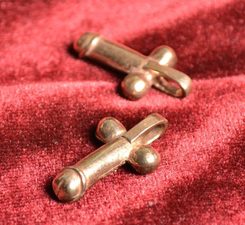
The historical predecessor of this phallus-shaped pendant dates from the 1st-2nd century AD and is now on display at the Spanish National Museum of Art in Mérida.
The hand on this Fascino clearly depicts the so-called Mano Fica gesture - a clenched fist with the thumb between the index and middle finger, which was meant to ward off the evil eye, misfortune and demons. The thumb here is seen as a phallus, while the fingers symbolize a stylized vulva.
Phallus pendants were used by the Romans in various forms to protect against evil, especially the evil eye.
Many of these pendants have been found at sites with a Roman army presence. Fascinum was therefore often worn by Roman soldiers as a good luck charm, probably to protect them from injury in battle.
In antiquity , Roman phallic pendants (Fascinum) served as protective amulets to ward off the evil eye (invidia) by symbolizing fertility, strength and prosperity, thus warding off evil forces.
They protected the wearer from the evil eye, served as a means of warding off envy and harmful looks that could bring sickness or misfortune, and were also meant to bring fertility, male strength, wealth and general prosperity.
In ancient Rome, phallic pendants were made in various forms (often winged, with other symbols, or depicting the mano fica gesture) in bronze, silver, and ivory, reflecting the Roman understanding of sexuality as an important life force.
Contrary to modern ideas, these pendants did not have an obscene meaning, but rather a positive and protective meaning in Roman culture. They were worn by soldiers, children and even horses.
- Material: bronze
- Dimensions: 3,5 × 1,8 cm


Related products